Moral Reconation Therapy® (MRT)
Moral Reconation Therapy (MRT) is a systematic treatment approach that seeks to decrease recidivism, or the tendency of a convicted criminal to re-offend, among juvenile and adult offenders by increasing moral reasoning. A cognitive-behavioral type of treatment approach, MRT combines elements from a variety of psychological models to address clients’ ego, moral, social, and positive behavioral growth, and research has shown that this type of therapy can increase moral reasoning in adult drug and alcohol as well as juvenile offenders. In addiction recovery treatment, MRT takes the form of individual and group counseling, and uses prescribed homework assignments and structured group exercises to address seven basic treatment issues.
Moral reasoning is how people make decisions about what they should or should not do in a given situation. Moral Reconation Therapy–MRT® fosters moral development in treatment-resistant individuals.
Correctional Counseling, Inc. (CCI) is the sole provider of MRT-based training and materials. MRT is used as a trusted intervention in 50 states and 9 countries because of these outcomes:
- Reduction in Recidivism
- Reduced Criminal Justice Involvement
- Reduced Substance Abuse
- Increased Housing Stability and Job Retention
- Increased Medication Acceptance
- Increased Treatment Adherence
- Improved Psychiatric Symptoms and Functioning
- Decreased Hospitalization
- Enhanced Life Purpose
- Raised Motivation
MRT Statistics
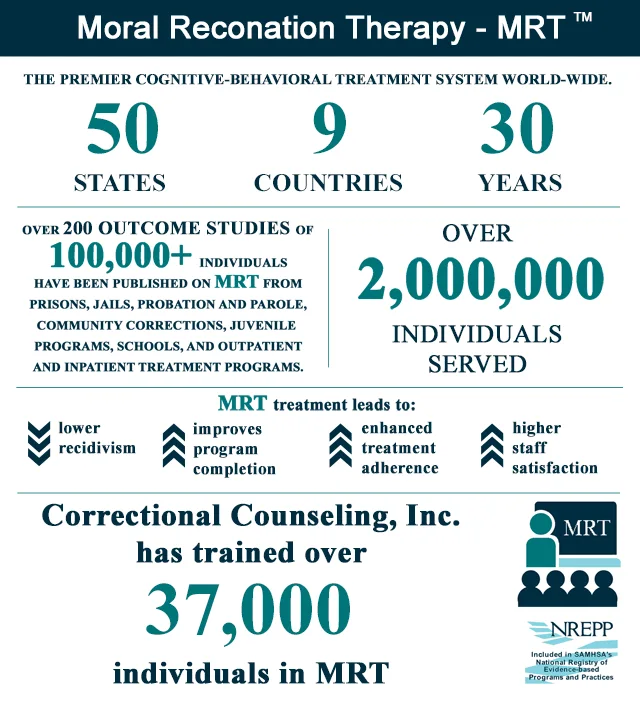
According to Correctional Counseling Inc:
30+ Years
Of proven behavioral results around the world with MRT, developed in 1985 by Dr. Gregory Little and Dr. Kenneth Robinson.
Up to 65%
Re-arrest and re-incarceration rates of MRT clients can be up to 65% lower than expected.
20 Years
Recidivism in MRT clients is significantly lowered, lasting for periods as long as 20 years.
$11.48 Saved for Every $1 Spent
The Washington State Institute for Public Policy estimated that the combined cost benefit to taxpayers and crime victims for the MRT program is $11.48 for every dollar spent.
$20,000
A cost-benefit analysis in 12 Virginia adult drug courts with MRT treatment showed lower outcome and victimization costs, along with lower placement costs, resulting in average savings of almost $20,000 per drug court participant. The drug courts are therefore cost effective.
17%
In a study of 19 MRT-based juvenile drug courts, the combined recidivism of the MRT-treated juvenile offenders was 35.7% compared to 52.7% in the comparison groups. This yields a reduction in recidivism of 17%, much better than the 6.5% average recidivism reduction reported in a large study of juvenile drug court results. (Mitchell, et al., 2012).